14 jul 2010

The end of Light bulbs

The end of Light bulbs
The National Act No. 26473, which prohibits importing and selling incandescent light bulbs is gradually moving forward throughout the entire country. This Act is expected to come into force as from January 1st, 2011.
Argentineans will have to replace incandescent light bulbs with compact fluorescent lamps (CFL), which are promoted as better light producers, since they are believed to save energy, which may result in a more efficient home economy and in the country’s possibility to overcome the serious energy crisis we are going through.
The use of compact fluorescent lamps has been promoted by the media since 2008 as an “energy-saving idea”. Low energy lamps are said to have a longer duration – an average of 6,000 hours, or in other words, 6 times more than incandescent bulbs.
As a way to propel the campaign to replace incandescent light bulbs, and in agreement with the Act unanimously passed by the members of the Congress, about 5 million of compact fluorescent lamps were distributed across the country free of charge. In our province, the distribution of the 114 thousand lamps sent by the national government was in charge of the local electric energy company, EDESAL, and the municipal offices.
While this campaign is carried out, and everyone replaces incandescent bulbs with CF lamps, no information has been given to citizens regarding the dangers of having incandescent lamps at home (they have a high content of mercury, a hazardous metal). No campaigns to inform about how to manipulate them has been made, and no regulations for their final disposal have been discussed.
Once the Act was passed, the Instituto Nacional de Tecnología Industrial - INTI (Nacional Institute of Tecnology) showed that many of these lamps have a shorter life span and are less efficient than what is indicated by the manufacturers. The INTI also declared that “if the lamp explodes, mercury goes out into the air, which causes a wide range of systemic effects on humans’ health, affecting kidneys, liver, stomach, intestines, lungs and the nervous system. Microorganisms convert inorganic mercury into methyl-mercury, a very toxic, persistent and bioaccumulative form of mercury which is easily absorbed by the gastrointestinal tract”. Other reports inform that mercury – if the lamp explodes - sticks to any type of textile fibers, including carpets, curtains, linen, etc, which may give off mercury fumes for a long time. Similarly, it has been proved that these lamps can damage the skin, since they emit UV rays, which may also cause vision disturbances and headaches.
A policy worth imitating is, for example, the one adopted by the European Community, which allowed saving 20% of energy on the one hand, and generating an additional 20% of energy, on the other, by using renewable sources. People in Brussels (Belgium) is provided with information on how to save energy by the electric energy company itself, and they also have access to soft loans to buy double glass windows, which make heating systems more efficient in winter.
Most toilets in Europe have two flush buttons, one for solid waste (which allows a full flush of the cistern), and the other for liquid waste (which allows half the flush of the cistern). This system for saving water is based on the fact that producing tap water consumes a lot of energy. In Colorado (USA), energy is produced through solar panels.
Unfortunately, the legal framework in Argentina makes it difficult to implement similar systems, but it is not impossible if the decision is made. It will be necessary to demand that legislators and leaders devote more time to environmental en energetic issues.

Tourism and Education

Argentina has a huge territory where all climates are possible, as well as a varied geography and landscapes which let one enjoy the contact with nature. It is the ideal territory to do adventure tourism, and it offers numerous opportunities for those who love this type of activities.
Adventure tourism is a type of tourism which is booming and which is becoming more popular in San Luis every day due to the fact that it implies choosing unusual destinations for holidays, changing sun and beaches for exploration and active sightseeing.
As a lecturer of the course “Tourism and Recreation” –which is part of the Teaching Training Program in Physical Education at Instituto de Formación Docente Continua (Teaching Training Center) “Juan Pascual Pringles”- I work on the description of adventure tourism activities through comments and analysis of different tourism service providers and emphasize all the tasks that must be done before planning. After that future teachers are instructed on fundamental concepts, necessary to plan those activities from a theoretical point of view.
In the following section, I will refer to the work carried out by Ivana Paola Cerizola, a fourth year student at the Teacher Training Program in Physical Education.
How to plan recreational-tourist activities
We must emphasize the following aspects:
Destination: place (mountains, plains, river area, lake area, etc.) - Climate – Indoor or outdoor activities (visits to museums, play areas) – Solutions to problems in the schedule.
The tourists and their needs: Number of people - Age – Fitness -Security (first aid kit and suggestions for being comfortable – for example, wearing a helmet when riding a bicycle, proper shoes and comfortable clothes, etc.) - Medical record.
All these recommendations must be given before starting the journey/activity, and as soon as the guide or the instructor for a particular activity is introduced.
What should be considered when travelling with students?
Destination: Does the place have basic health services? How old are the students? Is there any specific characteristic which should be considered?; Special education needs; How many students travel?; Which activities will be prepared for those students who do not travel?; What time will they leave school?; Why is this trip organized? Objetives and educational content; How will other areas or subjects collaborate with this activity in order to be considered interdisciplinary? What will we do when we get to the place?; How are we going to get there (transportation); How will the activity be financed? (Will it be sponsored by the school? will the students pay for it? How many people are necessary to work on this activity? (Number of teachers, instructors, etc.); How should the students prepare for the activity? (clothes, proper shoes, bags, food, solar protection, etc.). It is important to remember that those topics which are intended to be worked in an interdisciplinary way must be dealt with before the trip.
Some final recommendations: do not forget to ask for parents’ authorization; (if it is an outdoor activity) do not forget to teach rules to project the environment; always think about an emergency plan in case of accidents (emergency phone number, first aid kit, knowledge of the closest  health center).
What must be considered during the trip? call the roll before leaving; check students periodically during the trip; remember basic behaviour rules; follow the schedule.

Guía Hueney in Santa Fe

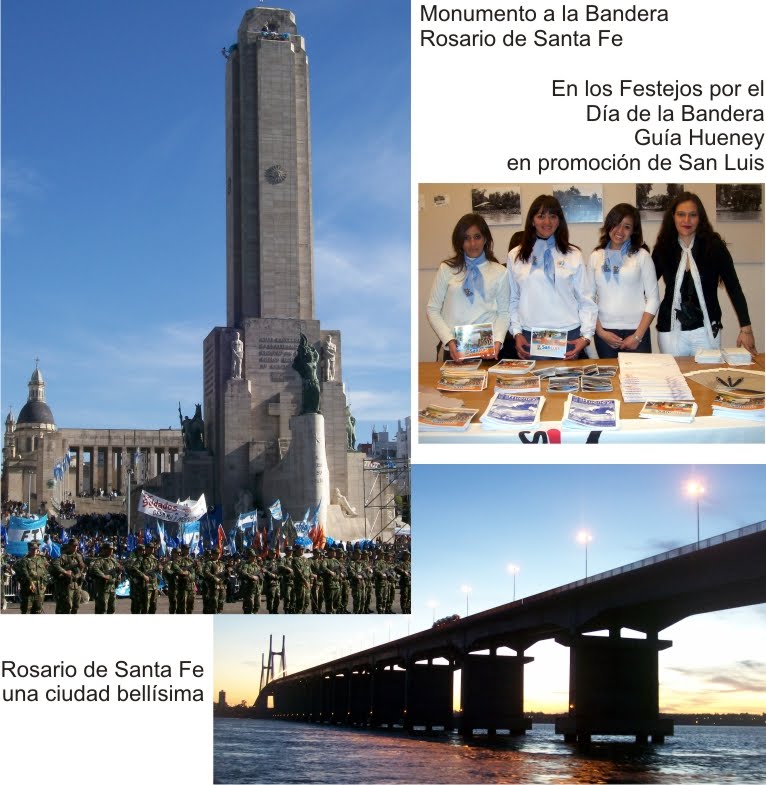
The beautiful city of Rosario celebrated the Flag`s Day with different artistic, cultural and sport activities during four days. 
Guía Hueney was there to introduce San Luis and its publications, together with Camtur (Cámara de Turismo de Potrero de los Funes [Potrero de los Funes Chamber of Tourism]), the Ministry of Tourism and other private organisms. 
Ente Cuyo, the tourism organization which brings together the provinces of Cuyo región - Mendoza, San Luis, San Juan and La Rioja - made also an excellent presentation.

More than a magazine

Guía Hueney is a project of work carried out by people from San Luis, and it is aimed at spreading information, as well as the work of those who collaborate with us. 
Throughout these four years, we have organized and/or participated in activities to reinforce our goals, and we have also been awarded prizes and the recognition of our followers.

* I Campaign: Sol, Agua y Sierras junto a Guía Hueney (Sun, Water and Hills with Guía Hueney)
* Artistic-photographic shows: “Naturaleza Partida” (Broken Nature) y “Arma Cabezas” (Mind-builders)
* Graphic and Online Editing
* Radio and televisión columns
* Bilingual editions
* Project for the creation of the Ecological Park “Las Aromáticas”
* Open doors days and micro-enterprise projects fairs
* Tourism:
Nogolí - La Carolina - Cortaderas
San Martín - Dique La Huertita
Potrero de los Funes - Buena Esperanza
Ranquel community - El Volcán - El Trapiche
* Certificate of Recognition for Working in favor of the Environment
* II Campaign: Eco 2008
* Edition, Design and Prologue of the book “100 años de Educación Permanente” (100 year of continous education)
* III Campaign: Ecological San Luis
* IV Campaign: Potrero Salud
* I and II Independent Art Park
* Natural Torism Attraction: El Cacique
* Numerous raffles
* Seminar on Climate Change “Rumbo a Copenaghe” (Towards Copenaghe)
* Medium invited to Gaby Herbstein’s photographic show “Huella Ecológica” (Ecological print)
* V Campaign: Aromatic Plants
* Discussion forum: “Cuidemos Nuestra Tierra” (Let’s protect our Planet)
* Fashion parade in aid to Betania Foundation and Ce.de.vida (Center for the development of children with Down Syndrome)
* Press coverage at Mar del Plata Film Festival (2008 and 2009)
* Proposal for the preservation of native forests
* Project for Protecting Natural Zones as tourist attractions
* Press correspondent in Spain
* Campaigns in:
Río Negro
Buenos Aires
Chubut
Córdoba
La Pampa
Santa Fe
* 1st International Meeting of Animal Abuse, Wellbeing and Behaviour
* I San Luis Book Fair - 2008
* “Ciudadano Solidario 2009" Award
* Book Project “Elijo Potrero, elijo San Luis” (I choose Potrero, I choose San Luis)

4th Anniversary

Hueney and Friendship
We celebrate one more year. We have made friends from the beginning of Guía Hueney, and now thousands of people share our views on art, culture, tourism and ecology. Born out of a dream of three friends (Nélida Olguín Frontini, Beatriz Peralta and Paola Irastorza), Hueney has now become a shared pleasure with people from Argentina and all over the world. It is always my pleasure to look forward into the future, towards dreams that make our lives happier and fill us with hopes for the future.
I always say: people who are with me are the best human beings. They are great, professional people, and above all, good friends. I thank you all of you for trusting Guía Hueney project and me. I send my love to my family, who are always present, at the right moment.

New RAFFLES to go on celebrating

Register via e-mail at guiahueney@hotmail.com or send us a text message to (+54-02652) 15-548696 with your name, the last three numbers of you ID, and the place you are from. Registration ends on August 23rd 2010.
You can win a weekend for four people in Potrero de los Funes, at Cabañas Paihuen. Visit the website at www.paihuensanluis.com.ar to know more about this place.
The raffle will take place on 08/24 on radio (Digital 101.1) program Artículo 21, at 9 a.m (local time) (www.radiodigitalsanluis.com.ar).

Lucky winners
In previous editions of Guia Hueney, the results of the raffle were published. The prizes included stays at Apart Hotel La Quebrada and Cabañas Viejo Caldén. The winners enjoyed an excellent service and lovely days to rest in Potrero de los Funes.
www.cabaniasviejocalden.com.ar - Tel: (02652) 15-244773

Winners: Laura Bello -  Gabriel Liguori

Hueney’s 4th Anniversary (San Luis, Argentina)

Guía Hueney is an independent publication.
A medium within the media...
A magazine to belong.

Member of CAMTUR (Cámara de Turismo de Potrero de los Funes [Potrero de los Funes Chamber of Tourism])
Member of FOAPRA (Spanish acronym for “Federation of Environmental Organizations and Animal Protection Organisms”)
INSPIRACTION Collaborator (Madrid-España)
Hueney exchanges information with PARTIDO VERDE (Green Party) (Lebannon)
Registered before Medios de Comunicación y
Publicidad (San Luis Government’s Media and Advertisement department)
Honorary members of Biblioteca Popular Urbano J. Núñez (Public Library) from Potrero de los Funes

Art, Culture, Tourism, Ecology

News from the sky

by Aldo Hugo Olguín

Professor of Mathematics, Physics and Cosmography

July 2010 will be an unforgettable month! July is known as the month of aphelio, the point at the year when the Earth is furthest from the Sun, which the Earth reaches every first week of July.
It is during this month that we can observe one of the most beautiful sights, and those who live in latitudes like San Luis’ have the privilege of being able to observe the very center of the galaxy we are part of, the Milky Way.
If we look up to the highest point in the sky (Zenith) at midnight, we will easily find Scorpio and Sagittarius, a zone densely populated by nebulous-like heavenly bodies which shine among the galactic dust and gas. Part of the zenithal light we will be receiving comes from the nucleus of the Milky Way, from a highly dense heavenly body located at the center of the galaxy at such a distance which can be calculated in about 25,000 years. Thus, we could ask ourselves: what happened on Earth at that time? What was the sky like?, and so on. The fact is that the light we see travels throughout the space for a long time, which varies according to the distance there is between the Earth and the object we observe – the furthest the object, the longer the time the light will take to get to the Earth; for example, it is 8 minutes from the Sun, it is 2 seconds from Venus, the star we see at dusk, and it is about 1 second from the Moon. What we see is no more than a reflection of the past.
Other extraordinary beautiful – though simple- events you cannot miss are:

- July 11th from 4pm (local time) on, partial sun eclipse (do not observe it directly. Use a perforated carton so that you can project the sun over another white carton. In this way, you will be able to see and take photographs of the sun without having your eyes hurt).

 - July 15th at dusk, heavenly bodies’ reunion: the moon will be near Venus, Mars and Saturn among the Leo stars (look for the crescent moon, next to the horizon at dusk, by the planets).

- July will say goodbye with a beautiful meteors rain which will finish by the end of August.

                                                Happy Friends’ Day for Everyone!

11 may 2010

Do not take the risk, go beyond …

Tourist Information

San Luis is a majestic and surprising province. There are valleys, hills, rivers, lakes and dams, hot springs and salt mines, symbols of prehistoric and modern periods, and remains of ancient ones. We invite you to meet nature and visit San Luis’ unique beautiful places. The starting point will be Km. 0, at Plaza Pringles. Do not risk your life, follow these recommendations. Go beyond.

Recommendations:
- Fill your car tank, and check the air in the tyres.
- Drive with headlights on when travelling through highways and routes.
- Always wear seatbelts.
- Always carry a plastic bag for garbage. Do not throw garbage through the car window. - Do not throw cigarette butts through the window, you could start a fire.
- Always hire tourist guides or local people who knows the place if you decide to go for a walk around the hills.
- Wear comfortable clothes and shoes, and a cap. Use sunscreen and carry fresh water.
- Do not forget to notify someone of your walk before you start (in case you get lost).

Recycling used batteries (Part I)

by Lorena Ávila Cantisani
Correspondent in Spain

Batteries are composed of different metals, such as mercury in button cell and alkaline batteries, or cadmium in rechargeable batteries. Other types also contain manganese, nickel and zinc. Not all batteries are the same, but they all have a high concentration of metals in their composition, which makes them toxic waste.
The development of technology has brought an increased consumption of batteries. Once batteries go flat and are no longer useful, they are disposed of anywhere, which is really hazardous to the environment. Batteries components can be reused provided they are properly recycled. A ton of batteries produce 600k of heavy metals.
The components of a single battery are enough to contaminate 40L of water during 50 years. If we think about this, we will be able to see the importance of recycling batteries more clearly.
How are batteries recycled?
The process starts by disposing batteries in proper containers. After that, they are carried to a recycling plant, where mercury is separated from other metals and materials which can be reused. Conventional batteries are chopped into small pieces within a nitrogen-refrigerated atmosphere. Once they are chopped, they are heated and condensed in a distiller.
A button cell battery can contaminate up to 600,000L of water.
In the plants for the treatment of mercury residues, such as Vaersa, in Buñol (Valencia, Spain), batteries are processed using a vacuum-thermal treatment, in which the mercury vaporizes. Vapor then passes to a combustion chamber where organic particles oxidize at a temperature of 800ºC. Finally, mercury goes through refrigerators, where it is condensed and turned into a liquid. The amount of mercury is not much, but it is 100% pure. Battery dust goes through different processes aimed at recovering the metals it contains. The useful ones are put to good use again, and the rest goes to the so-called landfills.
Other types of batteries are collected by authorized retailers, who take them to special disposal facilities.In Spain, the Ministry of the Environment regulates the processes that all types of toxic waste must go through, especially batteries.
There are also many organizations which collaborate in collecting spent batteries. ECOPILAS (Foundation for the Environmental Management of Batteries) was set up by the following companies: Cegasa, Duracell, Energizer, Phillips, Kodak and Sony, which are members of the Asociación Multisectorial de Empresas Españolas de Electrónica y Comunicaciones (ASIMELEC). The aim of this organization is to implement the first integrated system of batteries management in the field of electronics, and to make the disposal of batteries an easier task.
AERPAM (Asoc. Española de Recogedores de Pilas, Acumuladores y Móviles) promotes environmental education and awareness-raising activities through information campaigns.
Everybody, from producers, dealers, public organizations, NGOs, and the community as a whole must become aware of the importance and need of recycling these elements.
It is estimated that every person uses 10 batteries per year in Argentina, and that those batteries are incorrectly disposed of when they are no longer useful.


Brightly lit battery containers in shops and streets. Valencia, Spain

Laurus Nobilis (laurel)

by José Luis Coria
Agronomist

Laurel is a beautiful tree that grows in gardens and parks. It has dark green leaves, and it is quite big. This species has special properties, among which we can mention its symbolic meaning of glory, power and victory, and others concerning health.
Its healing power is used in essential oils to mitigate neuralgias, rheumatic pain and skin diseases. The smell of burnt leaves purifies the air. Laurel leaves are also used in infusions to alleviate exhaustion, lack of enthusiasm, stomach ache, and respiratory diseases. Just 10g of leaves in 1L of water will be enough. Heat until boiling point, and drink 3-4 small cups everyday (always ask you physician first).
Bay leaves are excellent for seasoning dishes, especially soups and stews. If you use fresh leaves, you will need a larger quantity.
Nowadays, hardly anyone remembers or makes use of plants healing properties. We know that drugs are expensive, and that many of their components are extracted from plants, but we do not know recognize them because many plants are called by their scientific names. All plant species have healing properties.

Towards the Bicentennial Anniversary

by Roberto Espinosa
Writer-Environmental Specialist

The Bicentennial Anniversary of the historical feat of May 1810 is just a few days away. Fireworks and sparklers shows will be broadcasted, and landmarks alluding to this historical date will be inaugurated. Lots of people will probably dance our traditional Pericón Nacional, as well.
Unfortunately, these ceremonies will take place, and none of the moral, political and social problems that gave rise to the movement leading to our Independence – which are still present and have worsened with the passing of years – will be dealt with. Again, we will have lost the chance to debate and agree on the kind of country we want.
Most Latin-American countries endure the consequences of demagogy and the simplistic speeches of politicians, whereas transnational corporations go on subduing these peoples, sacking, destroying and contaminating their natural resources without any type of restriction.
Consider what is happening in Argentina:
·        Foreign mining companies – which our legislation allows to work in the country without almost any control–, are destroying the enormous natural richness kept under our soil, thus destroying important natural environments, and contaminating rivers, brooks and glaciers.
·        Million hectares are being deforested to cultivate soybean, which is later exported. Nineteen million hectares were sown during the last productive campaign. We must consider that when soybean is exported, the fertility of our soil, and large volumes of water (2,500/3,000 m3 per ton) are also sold, and that the indiscriminate use of agrochemicals makes our soil barren and contaminates our rivers. This year, Argentina will export 58 million tons of soybeans.
The well-known sustainable development programs are carried out by deploying natural resources. Thus, environmental problems are caused by political and economic wrong decisions, just as poverty and famine.
The constitutional right to live in a healthy environment (section 14 of Argentina’s National Constitution) must be considered as a basic human right, a pre-requisite and a basis for others rights – human, economic and political  - to be enforced. A healthy environment is a sine qua non for living: no other right can be enforced in an unhealthy or altered environment.
¿Do we have to wait until the tercentennial anniversary to think about these topics?

9 may 2010

The Animal Day (…is everyday)

[i]Who is the beast?

Observing respect for animal rights makes us better persons.

Last April 29th, we celebrated the Animal Day with activities aimed at raising people’s awareness on the proper care for animals, no matter whether they are wild or domesticated. The celebration took place in Plaza Pringles, in San Luis, together with representatives of the following organizations:


Argentina’s Criminal Code considers maltreatment and cruelty practices against animals as a misdemeanor offense punishable with prison in periods ranging from one (1) month to one (1) year.


[i] This question makes reference to an expression used in Argentina to denote a person who misbehaves.

Tourism and Education

by Luis Omar Miranda
Teacher and Programmer

San Luis projects itself as an important tourist destiny, both at the national and at the local levels. For this reason, it is necessary to improve the practice of this activity; it essential to improve both the infrastructure and the quality of human resources, the last of which is of outmost importance due to the fact that those people are the ones who deal with tourists. We must give a high value to education and training in any of the areas related to tourism, especially in those involving services and entertainment. In this way, we would avoid improvising and offering low-quality tourism.
Most tourism companies are family-run busnisses; parents and children alike share tasks and responsabilities. That is why it is very important that people pursue studies –secondary, tertiary or university) in areas related to tourism. There are several educational institutions which offer courses on tourism and related fields in San Luis.
There are three secondary schools offering training oriented to tourism, namely:
1. Colegio Nº 8 Mauricio P. Daract – where students graduate with a certifícate in Production of Goods and Services, or a certifícate in Recreation and Tourism. Through an agreement with Instituto Tecnológico from Universidad de a Punta, students can be directly admitted to the Tourism and Business Management programme.
2. Centro Educativo Nº6 Subsecretario Carlos Sadoc San Martín in El Volcán - where students graduate with a certificate in Recreation and Tourism.
3. Centro Educativo Nº19 Domingo F. Sarmiento, in San Francisco del Monte de Oro - where students graduate with a certificate in Spare Time and Tourism.
At the post-secondary level, Instituto Politécnico y Artístico Universitario –which is a branch of Universidad Nacional de San Luis – in Merlo offers the following programmes: University-level Tourist Guide, University- level Technician in Hotels Management, and University-level Technician in Tourism Management. Universidad Católica de Cuyo offers a graduate programme in Hotel Management and Tourism. Universidad de la Punta offers a technical programme in tourism.
The training options in the field of tourism are quiet varied. In the next edition, we will deal with the teaching of foreign languages, an area of vital importance for tourism.

Hueney gives you more!

by Paola Irastorza
Director of Guía Hueney

Guía Hueney – bilingual edition
This month we are launching a bilingual edition with the purpose of furthering cultural exchange. Visit http://guiahueney.blogspot.com to read some of the articles in English. Graciela Lucero Arrúa (Sworn Translator) will be in charge of the translation of the articles. I would like to welcome her as part of our editorial team.

Raffle
We will be 4 years old in July, and we will celebrate this with a raffle. Win 1 day accomodation for two people in the recently built hotel “Cabañas Viejo Caldén”, in Potrero de los Funes, San Luis (Argentina).
Visit http://guiahueney.blogspot.com and e-mail us to guiahueney@hotmail.com, or text us to +54-02652548696 in order to participate. Tell us the name of the company in charge of the translations. Do not forget to send us your name and your ID number. The raffle will take place on June 21st 2010.
Participate and win to belong to Guía Hueney!

The articles in this magazine are written and revised by professionals and students in different areas. Please acknowledge the source when citing them.

News from the sky

by Aldo Hugo Olguín
Professor of Mathematics, Physics and Cosmography

During May and June, our planet will go around Virgo, Libra and Scorpion constellations. We will be able to see their stars high in the sky during the long and dark winter nights. 
Once in the dark of night, we will be able to see how the Southern Cross sets itself in vertical position, just like the hour hand of a huge clock pointing to the south.  Scorpion will be easy to spot because of its question mark shape, and because it is made up of stars set from north to south in the sky. Antares, the red star at the center of the constellation, symbolizes the heart of the scorpion, a mythological animal.
At this time of year, days become shorter and nights become longer, the sun is inclined more to the north, and loses some of its brightness, whereas the moon  and the planets can been seen brighter and higher in the sky. By the 22nd of June, the sun starts reducing its inclination to the north and begins its return. This period, which extends from June 18th to June 26th, is called still sun, or Winter solstice in the south hemisphere, and it marks the change of the season.  Stars are more visible than usual, and since weather conditions are generally good, we just need to be well wrapped -up and to sit comfortably to watch the sky. 
Venus will be the morning star, and it will be next to the moon by May 16th. This will be a great show at dusk! On May 23rd, Mars (the red star), Saturn (the yellow star), and the crescent moon will be together at dusk. Do not miss this! While observing, you might be surprised by a beautiful shooting star … make a wish!